Filey Church monuments
St Oswald Church, Filey, on the Yorkshire coast, is mostly of interest architecturally, as a late Norman-Early English church. It contains however around 20 simple panel monuments.
The Church:
The Church of St Oswald, Filey, on the east coast of Yorkshire where the North and East Ridings meet, is a picturesque cruciform building with a central squat embattlemented tower. The nave and aisles have battlements too, and there are heavy buttresses at the corners and on the porch.
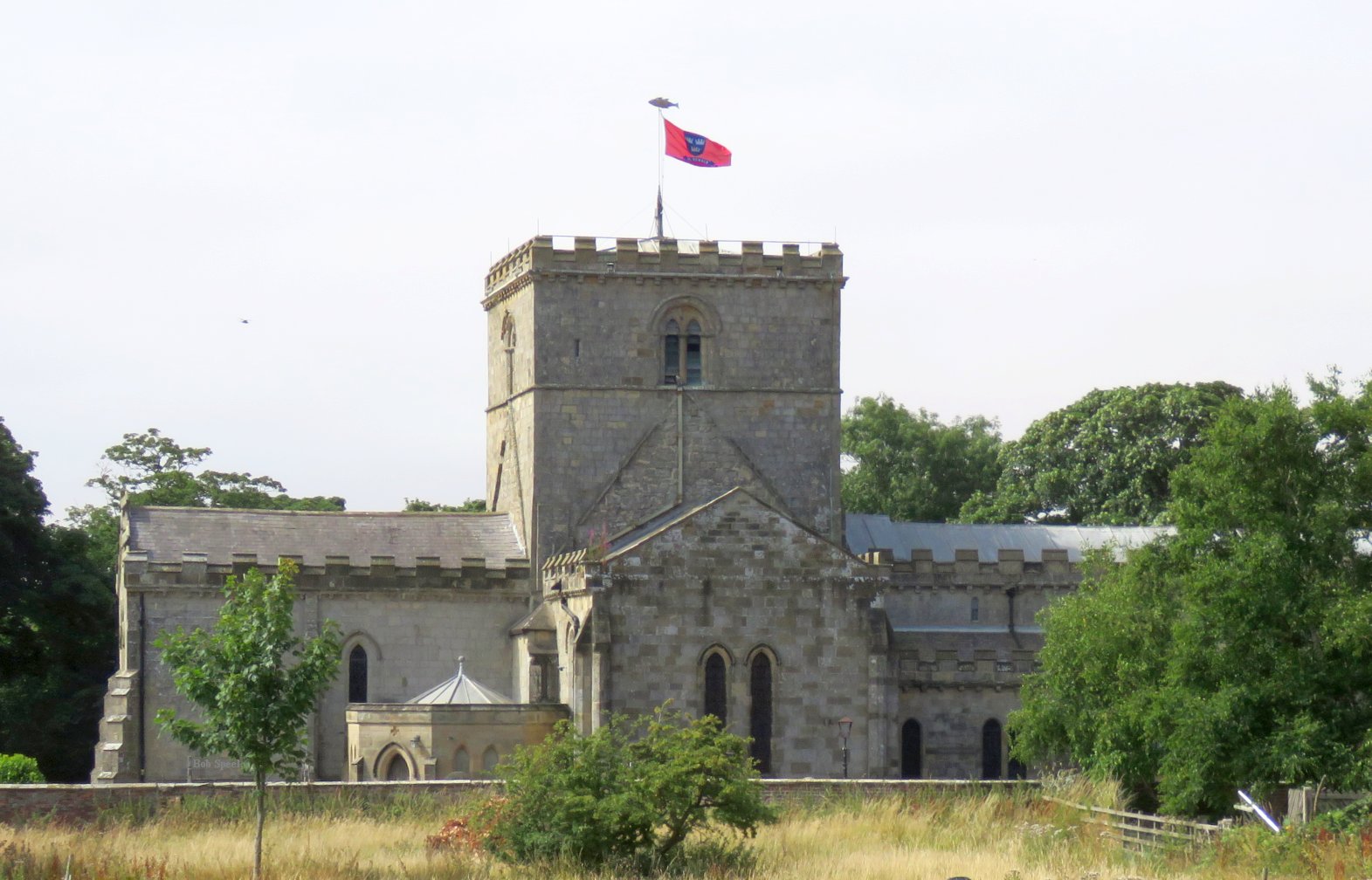
Filey Church, Yorkshire.
The structure is Norman and Early English, being principally 12th and 13th Centuries, including the characteristic lancet windows in the chancel (the nave ones are 19th Century below, and small Norman lancets above in the clerestory, which can only be seen from a little distance), with the battlements added in the 15th Century, Victorian restoration and porch, and a bit of 20th Century work. Information on the Church website suggests it was likely founded by Augustinian friars of nearby Bridlington. The north door, late Norman, has four orders.
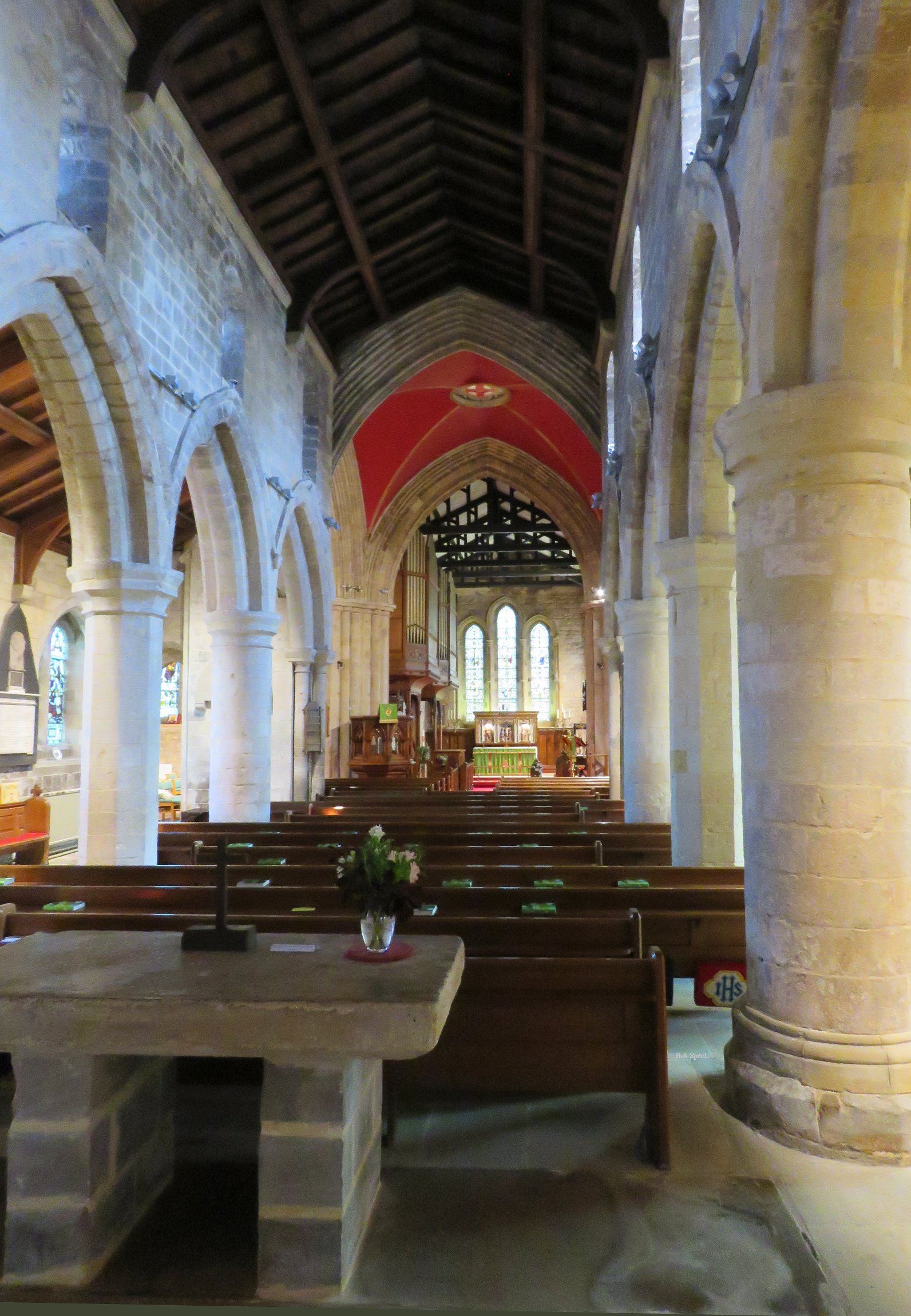
Inside, the pillars to the nave are a notable feature, part Norman, but with pointed arches. There is much exposed stone, wooden furnishings, and a good ancient ambience. The monuments are scattered throughout the Church.
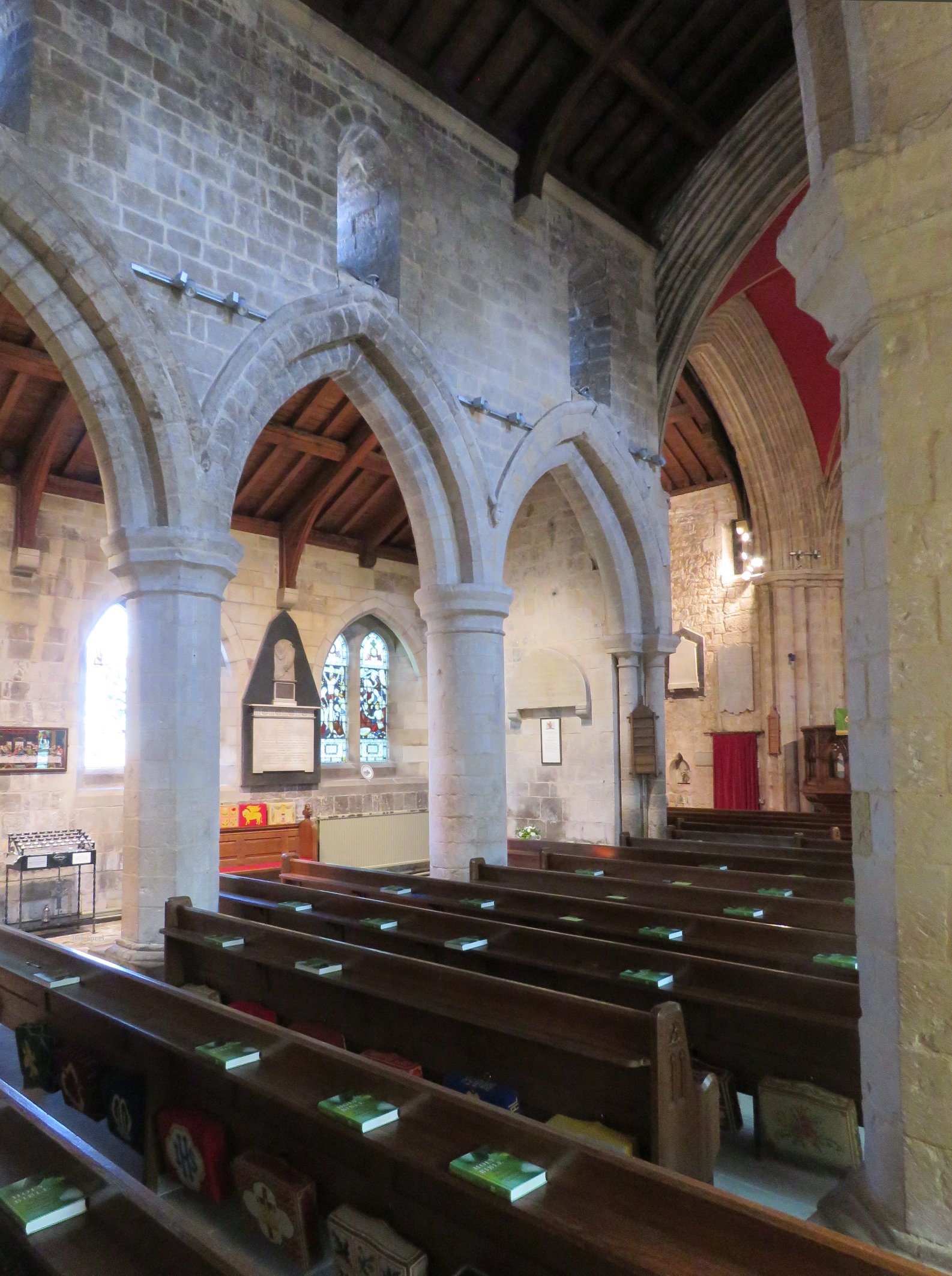
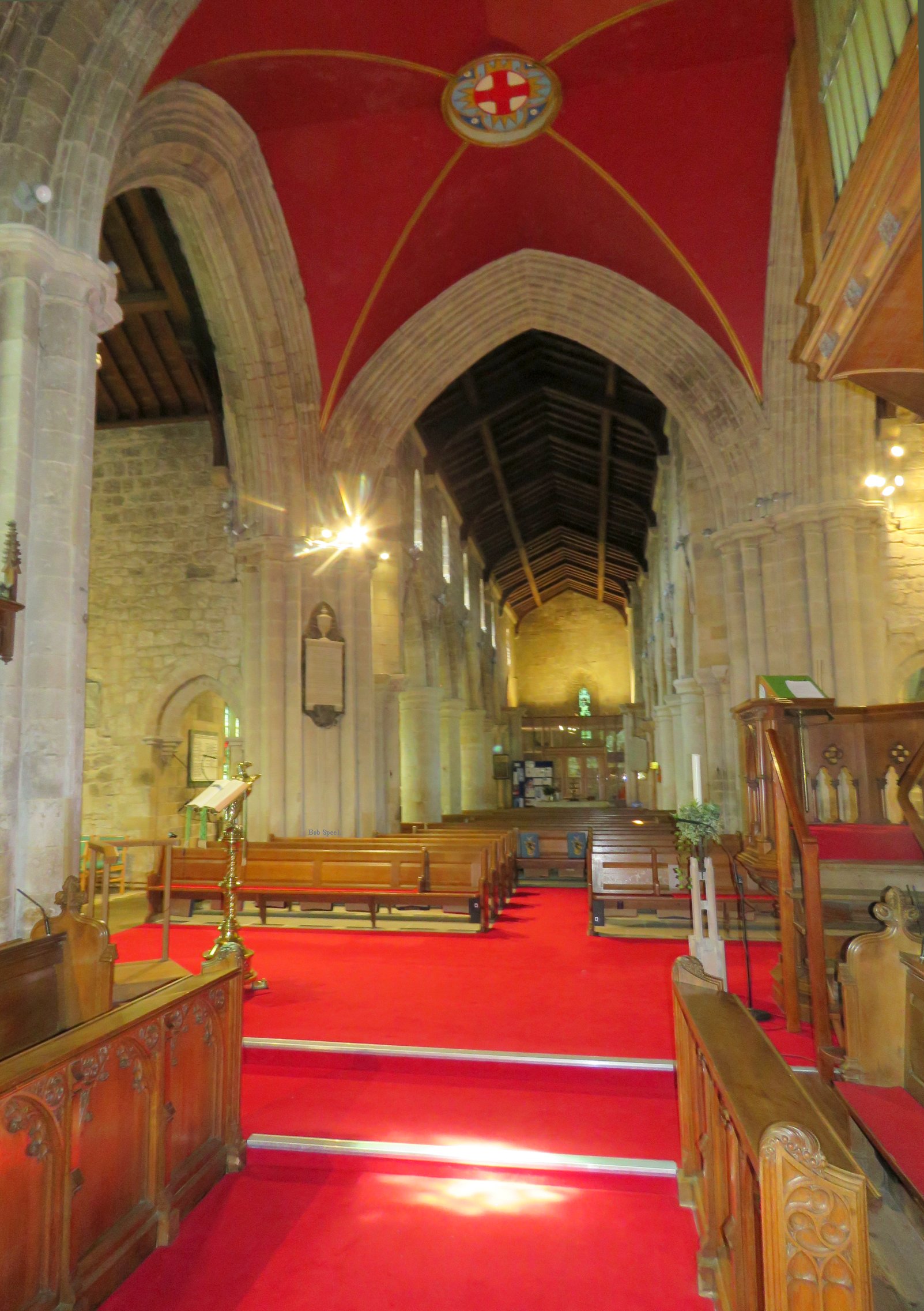
The Church interior, showing pillars and central crossing.
Monuments
There are around 20 panel monuments from the mid 18th-20th Centuries, tending to the simple and with minor decoration at best, but nevertheless with a couple of ones of sculptural interest, and showing a variety of forms of the white-on-black panels which predominated towards the end of the 18th and into the 19th Century. And several are visibly signed by their makers. We take them in roughly date order:
George Beswick, d.1739, of Gristhorp [the surname is written more like Besivick], and his daughter Mrs Eleanor Beswick, d.1750, of Scarborough. The inscription is on a plain semicircle of marble, with no border or embellishment preserved (picture below left, click to enlarge or hover for caption).

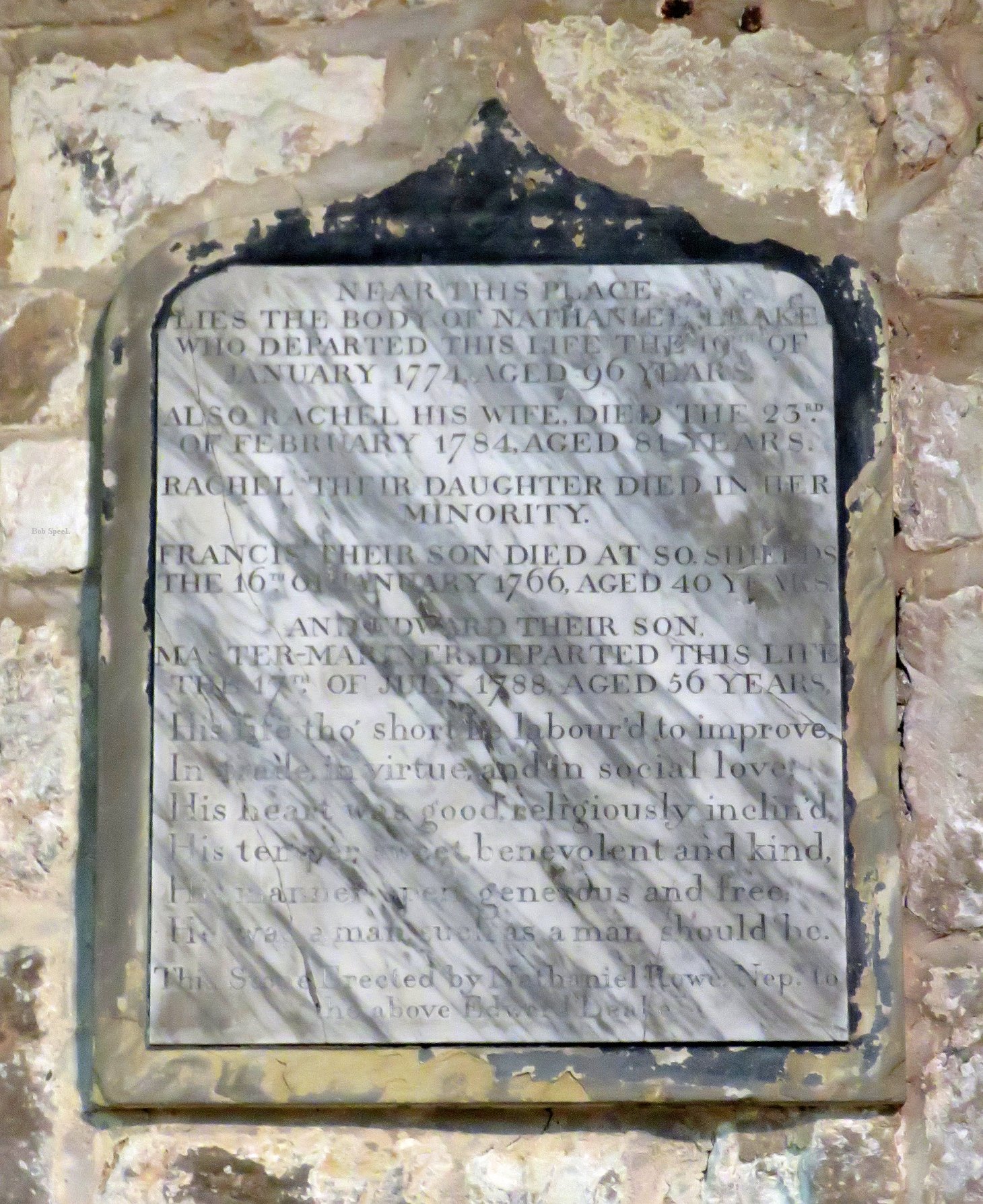
18th Century panels.
Nathaniel Leake, d.1774, wife Rachel Leake, d.1784, daughter Rachel Leake, undated, son Francis Leake, d.1766, and another son, Edward Leake, d.1788, Master Mariner. On a strongly streaked marble panel with a border and curved top ( picture above right).
Robert Beswick, d.1790, of Gristhorp, and Robert Goston [Gofton], d.1789, erected by Elizabeth Beswick, widow of Robert. Plain white panel cut with wavy top on two blocks.
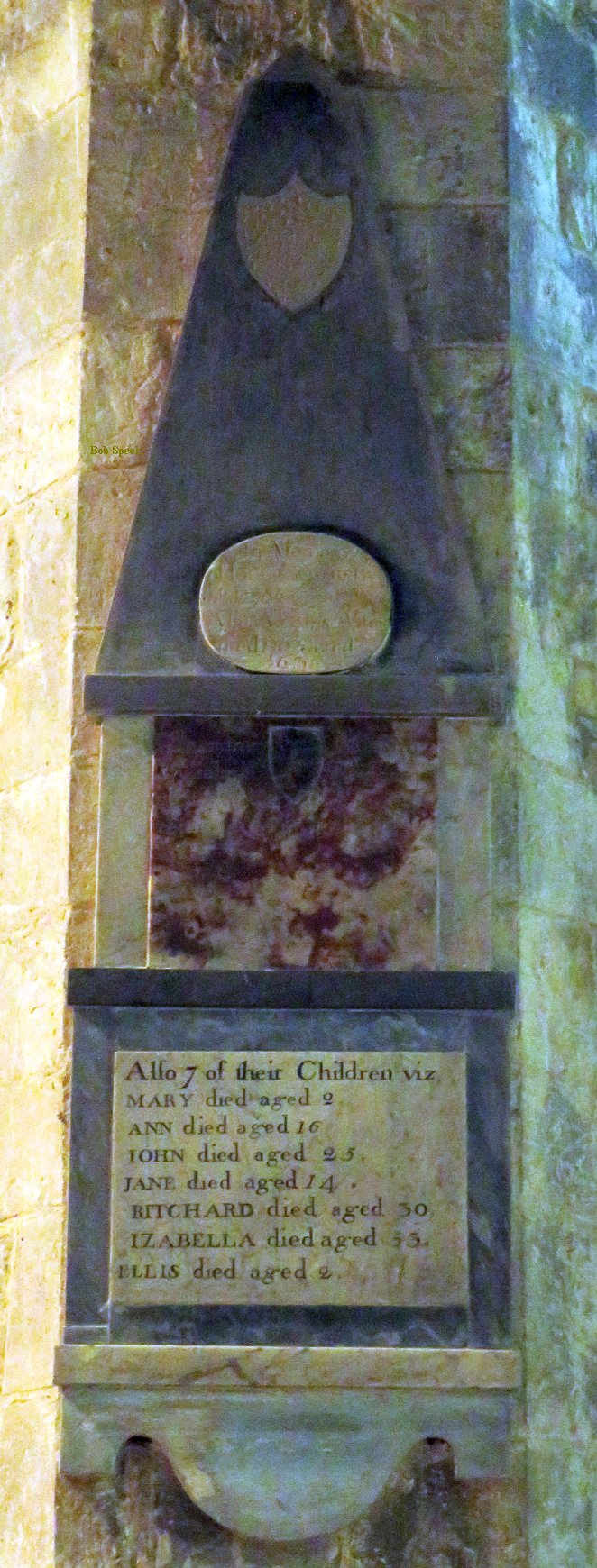
John [Campbell?], d.1796 and his wife Anne, and seven children, all of whom died young. An obelisk monument (see this page for lots of examples of that sort of monument). The dark obelisk occupies the upper 2/5 of the monument, with shield of arms and the parental inscription upon it; then a central shelf and a colourful centre with likely missing side pieces, and then a lower part with the second inscription to the offspring with a dark frame. At the base, another shelf and then a curvy apron. See picture at top of page.
George Beswick and family, which I could not read plainly, through to John Wilson Beswick, d.1830 or 1850. With upper shelf on which sits the family shield, with the black backing cut to form a pediment of sorts. This is the first-dated of the white-on-black panels in the Church.
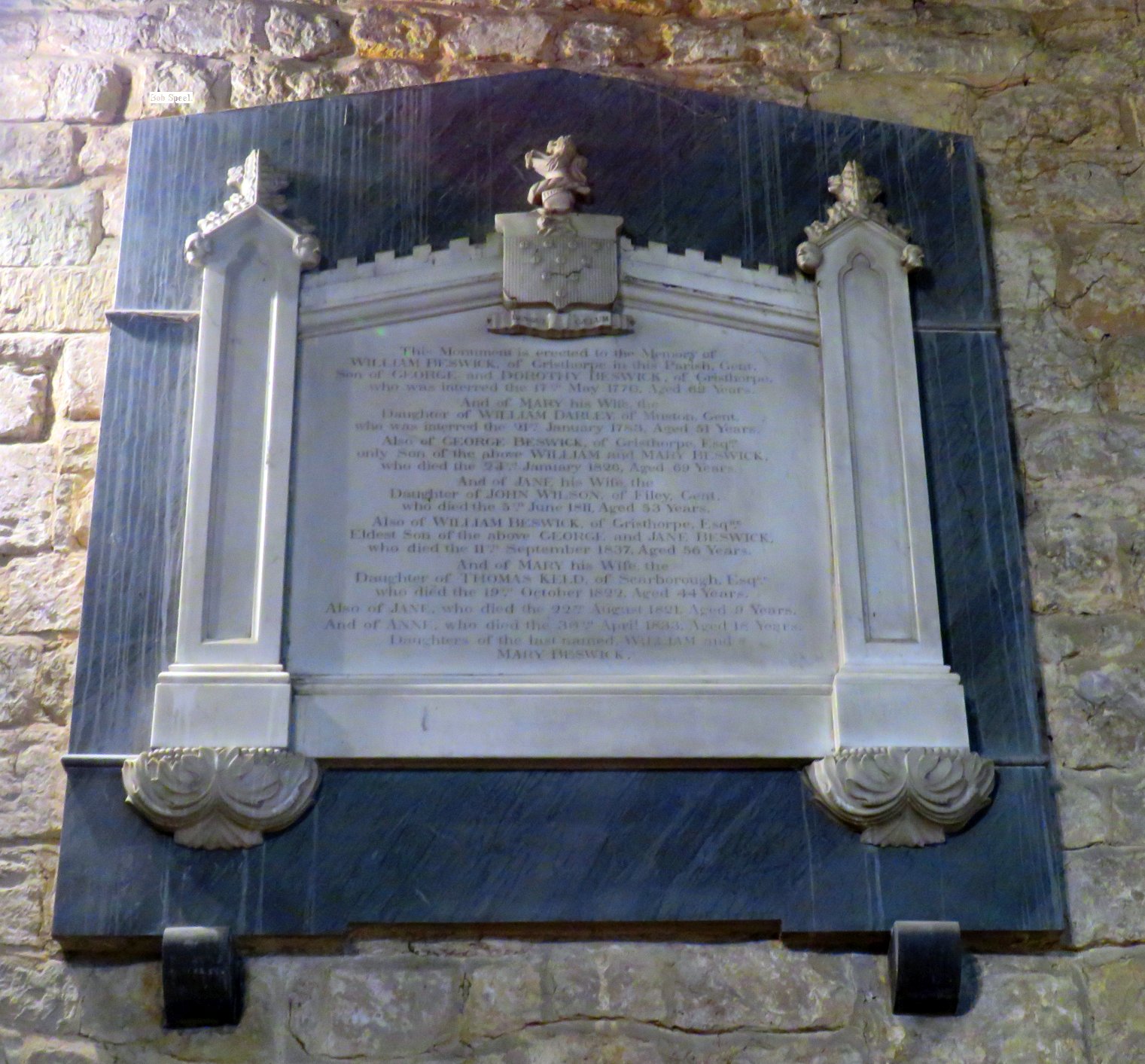
R. Hayes of Beverley, panel to William and Mary Beswick.
William Beswick, d.1770, son of the above, and his wife Mary [Darley] Beswick, d.1783, and others through to 1833. With sidepieces bearing incised windows to the sides, each with a little roof, pitched at the centre with a central shield of arms. There is a measure of carved ornament: crenelations, carving on the side roofs, and somewhat floral supports. On a black backing, signed on one of its supports by R. Hayes of Beverley, who also has work in Beverley Minster and in York.
Christopher Foster, d.1792, his wife Elizabeth Foster, undated, offspring John shaped backing Foster, d.1787, Elizabeth Foster and Frances Foster, undated. Also siblings to Christopher Foster, John Foster, d.1764, and Frances Read, d.1788. And noting the deaths of two unnamed grandchildren, to George and Ann Fowler of Scarborough. A pot carved in high relief above the inscribed panel, which bears an upper shelf and feet below, with minor decoration; the backing is a finely banded dark marble cut with a bell shaped top and wavy base, signed by the stonemason, Chambers of Scarborough.
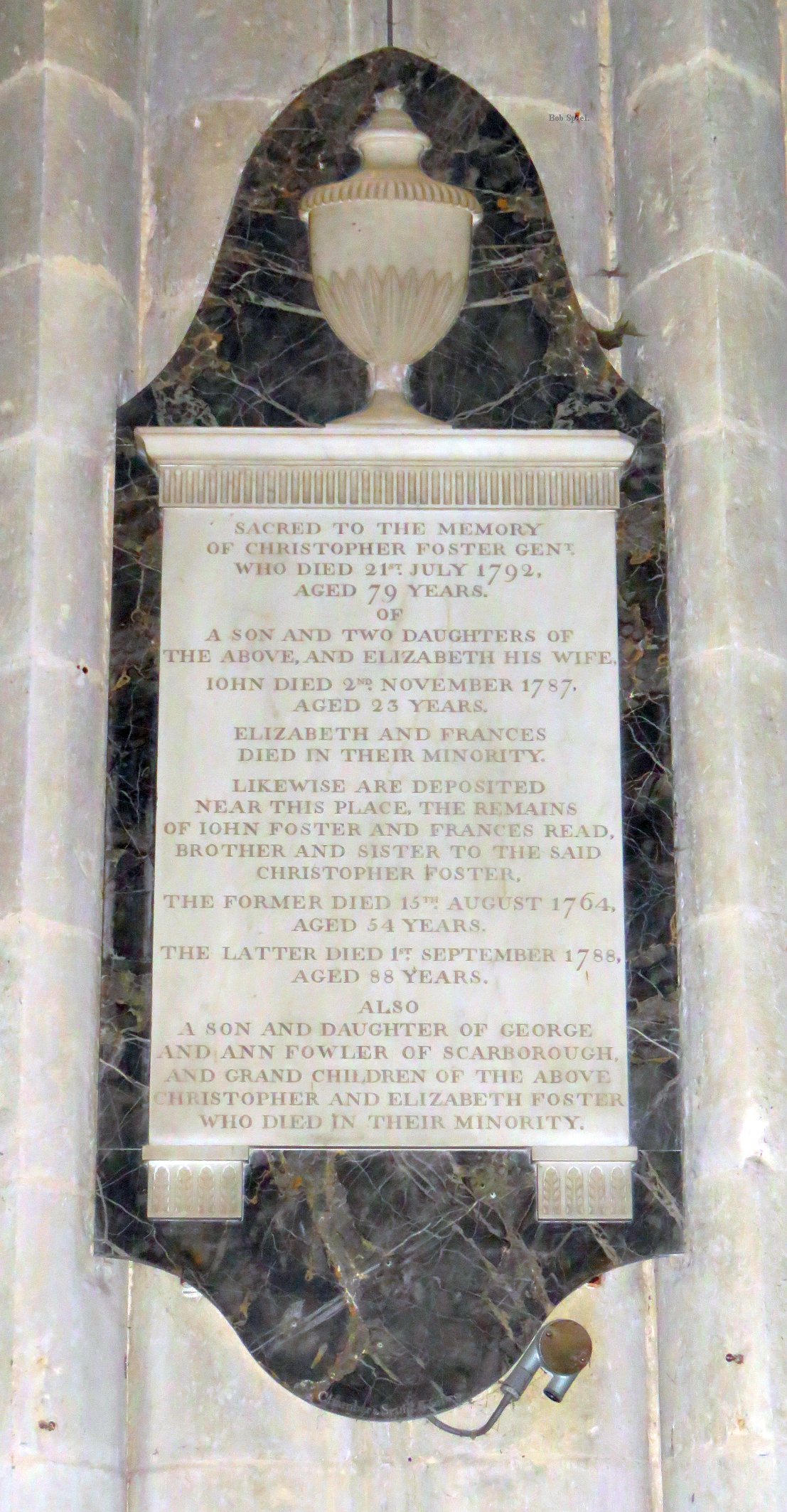
Foster panel.
Mary [Camish] Crabtree, d.1803, and on the apron, her husband William Crabtree, d.1808. An unusual panel. The main inscription in nice italics on slate, with an extra bit of verse on a white panel at the base (the side ornaments are missing), a frame of dark marble with white trappings and corners, and pair of mini skull and cross bone sets and compasses carved above, below an open book with a winged angel head above it, representing bible and soul ascending. Behind that, a curved backing, likewise at the base with scallop and carved flower.
Robert Shepherd, d.1813, of Lebberstone, aged 95 years, his successive wives Mary Shepherd, d.1800, and Ann Shepherd, d.1806, and offspring through to 1827. An obelisk monument, rather simply constructed for the style. On the front of the black obelisk, in white marble is a relief urn, partially draped, and clearly cut from a rectangular block of marble. This sits on a plinth with coloured inlay, supported on the central shelf which is a characteristic of obelisk monuments. Beneath, the inscribed panel, with simple stylised flowers carved at the top.
William Francis Watt, d.1838, of Beverley, and daughter Isabel Watt, d.1838, an infant. Blocky panel with lower shelf and cut to pediment shape above, on dark streaky marble base, both with little supports, signed by stonemason A. Shaw of Hull.
Dorothy Tiffin, d.1846, wife of the Beeford Rector, shaped white panel on grey backing
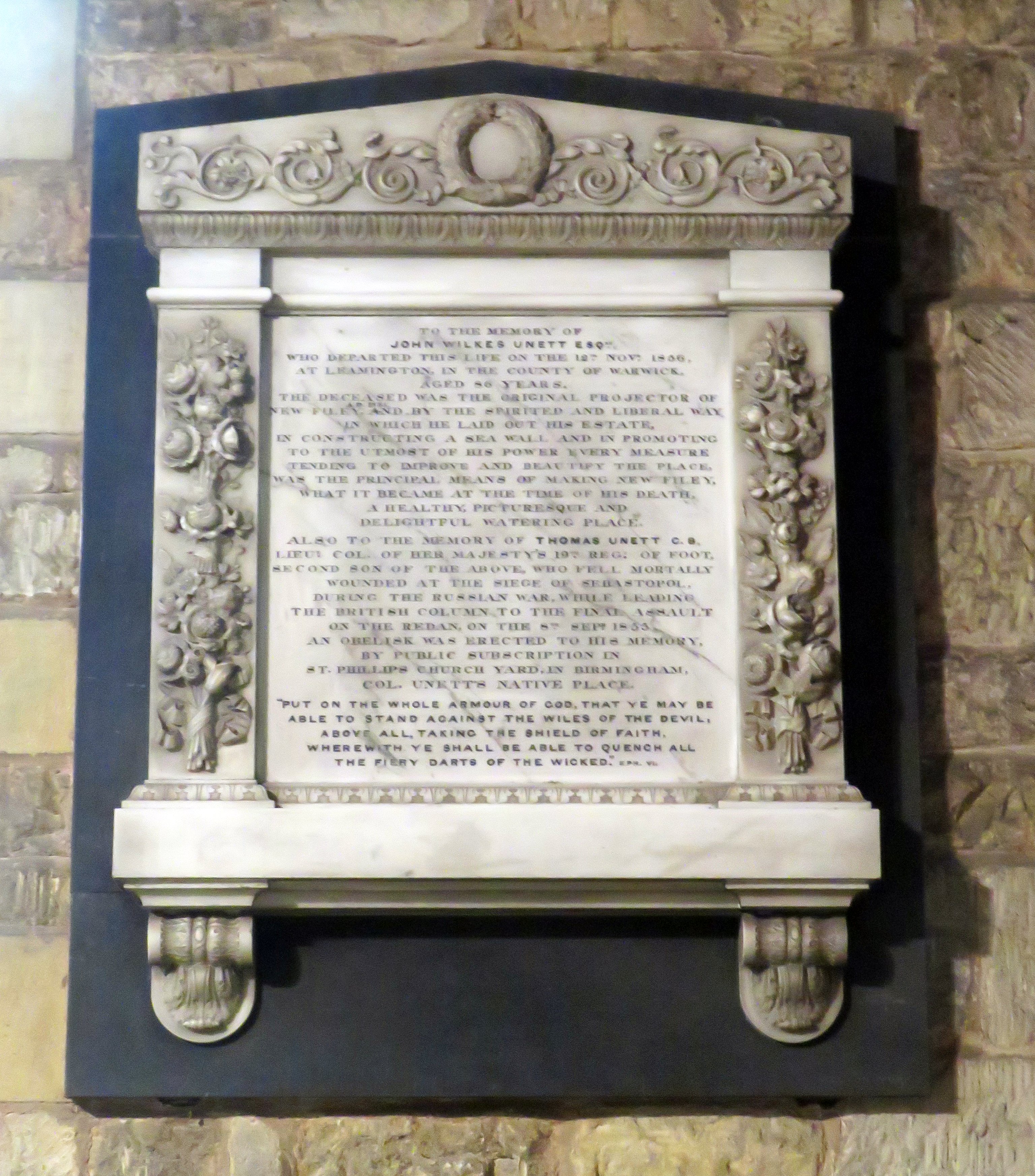
Carved panel by Skelton.
John Wilkes Unett, d.1856, and a son, Lt.Col Thomas Unett, d.1853 at Sebastopol, noting that an obelisk was erected to him in St Phillips Churchyard, Birmingham. The elder Unett built a sea wall, and is described as being the principal promotor and benefactor of New Filey. An ornate white-on-black piece, with a blocky upper pediment decorated with leafy scrolls and a wreath, and to the sides, flowering stems, carved in relief. Supported on a lower shelf with curly brackets, and signed on the black backing by Skelton of York. He is Matthew Skelton (1772-1844), and has a number of Classical panels across Yorkshire, including one in York Minster - the work of his I have seen shows this piece as characteristic, especially in the highly decorated sides to the frame of the inscription. See picture above.
Thomas Robinson, d.1798, of Filey, his wife Margaret Filey, d.1826, son Ralph Robinson, d.1851, and wife Bridget Robinson, d.1861?. White panel cut as a shield on a shaped black backing.
Thomas Alison Scott, d.1900, at Winburg Orange River Colony, a Volunteer in the Middlesex Imperial Yeomanry. An Arts and Crafts style beaten metal panel, with simple leaf designs on the border, and an enamelled Union Jack shield at the base, made by the Keswick School of Industrial Arts in Cumbria.
Martha Ellen Ramsden, d.1903, with the inscription on a while panel carved as a sheet of parchment curling at the edges, affixed to a backing in the form of a cartouche. This latter being a device of previous centuries, but here rendered in the Arts and Crafts favoured pinky alabaster. Elegant and a good piece.
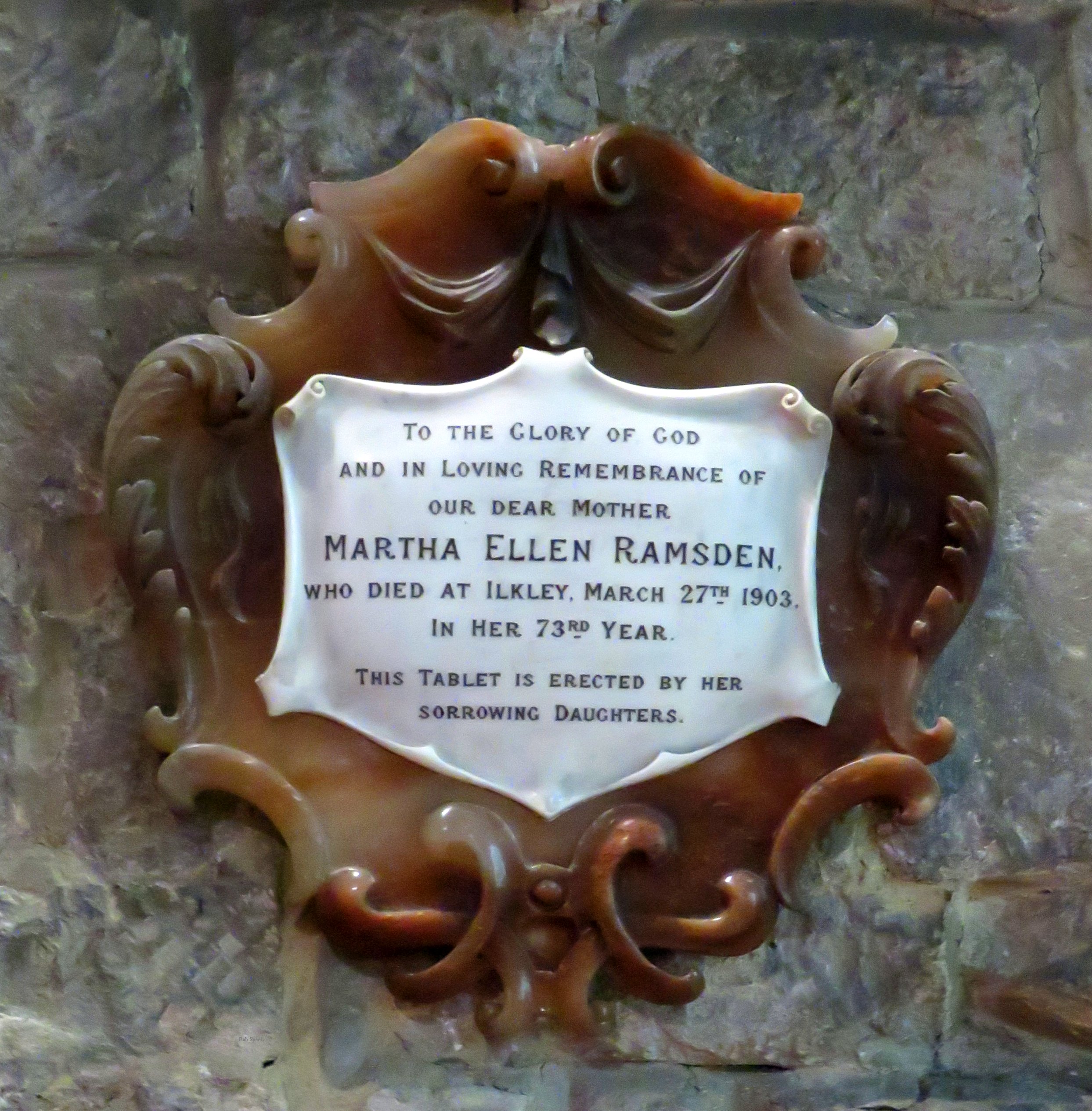
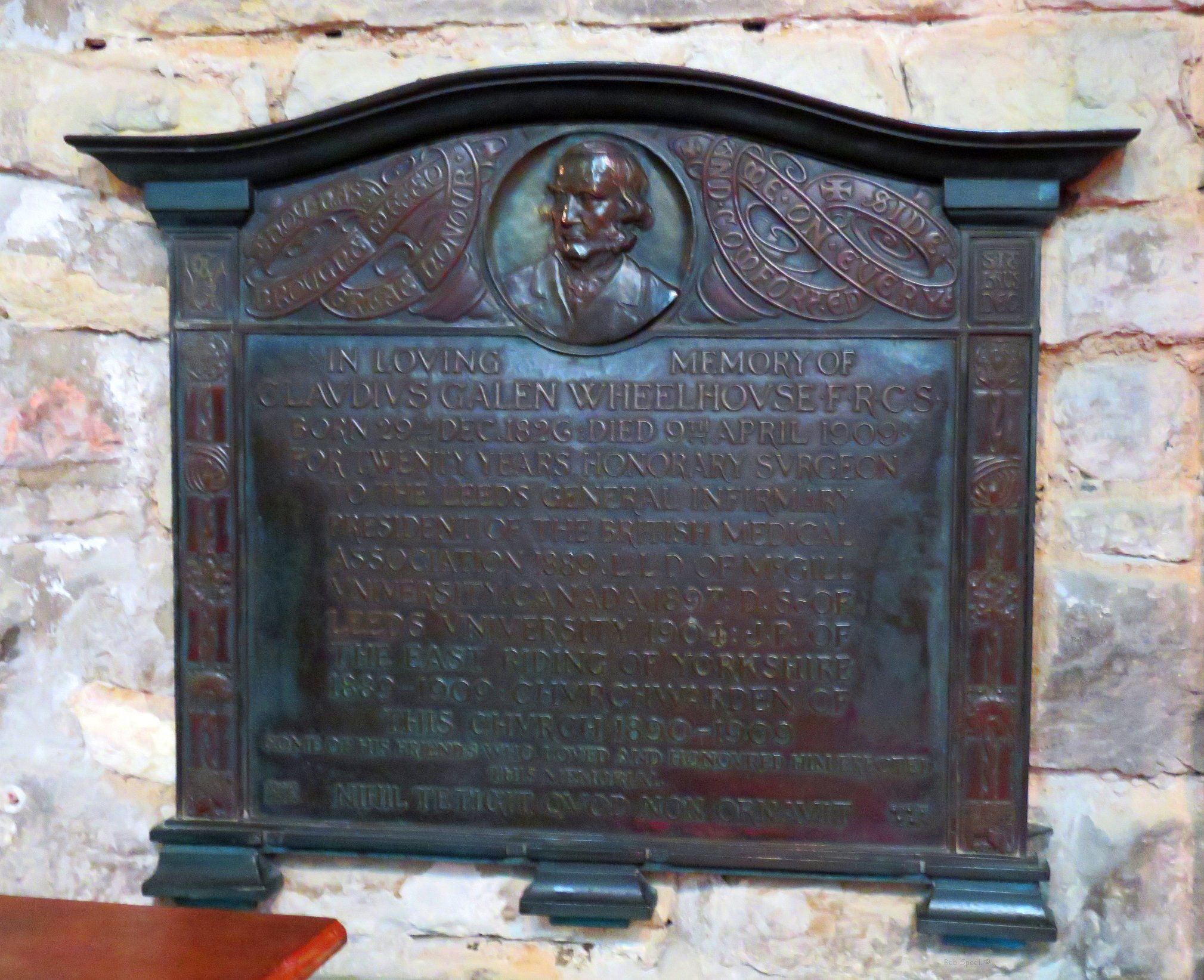
Ellen Ramsden, Claudius Wheelhouse, Arts and Crafts period.
Claudius Galen Wheelhouse, d.1909, with various medical titles and a churchwarden. Coppery panel with a small portrait bust in high relief above the inscription, flanked by ribbons bearing mottoes, decorated sides and canopy. Decorative.
Arthur Travis Clay, d.1919, plain panel carved with a frame noting the Church tower was repaired in his memory in 1929. The first of our post-WW1 tablets, when decoration was out, plainness in – we note three more:
Henry Foster, d.1948, Churchwarden for 35 years – plain panel carved with a frame.
Arthur Nevile Cooper, d.1943, Vicar of Filey 1880-1935 and Canon of York 1915-41. Plain panel with frame.
Benjamin Brown, Churchwarden until 1975, and Arthur Walker, d.1988, two small plain panels.
There were also three or four other plain panels which I was unable to read.
Also in the Church
Norman-style font, though dating from the 13th Century apparently, with round bowl and single great stem.
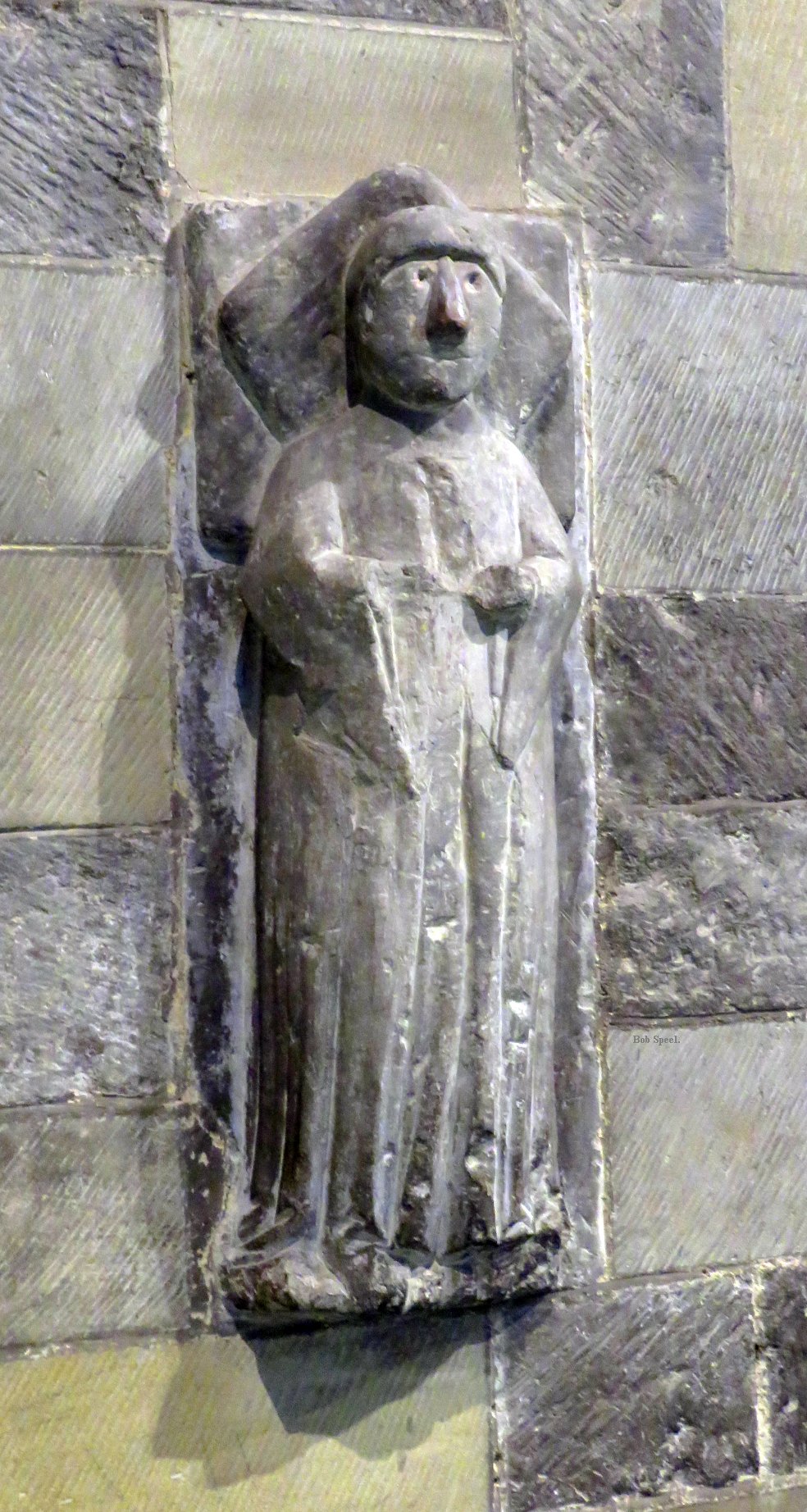
A crudely carved figure of a priest, with long robes, cowl and sleeves, also 13th Century. See picture at top of page.
Sedilia (three recessed seats under arches to right of altar as we look at it).
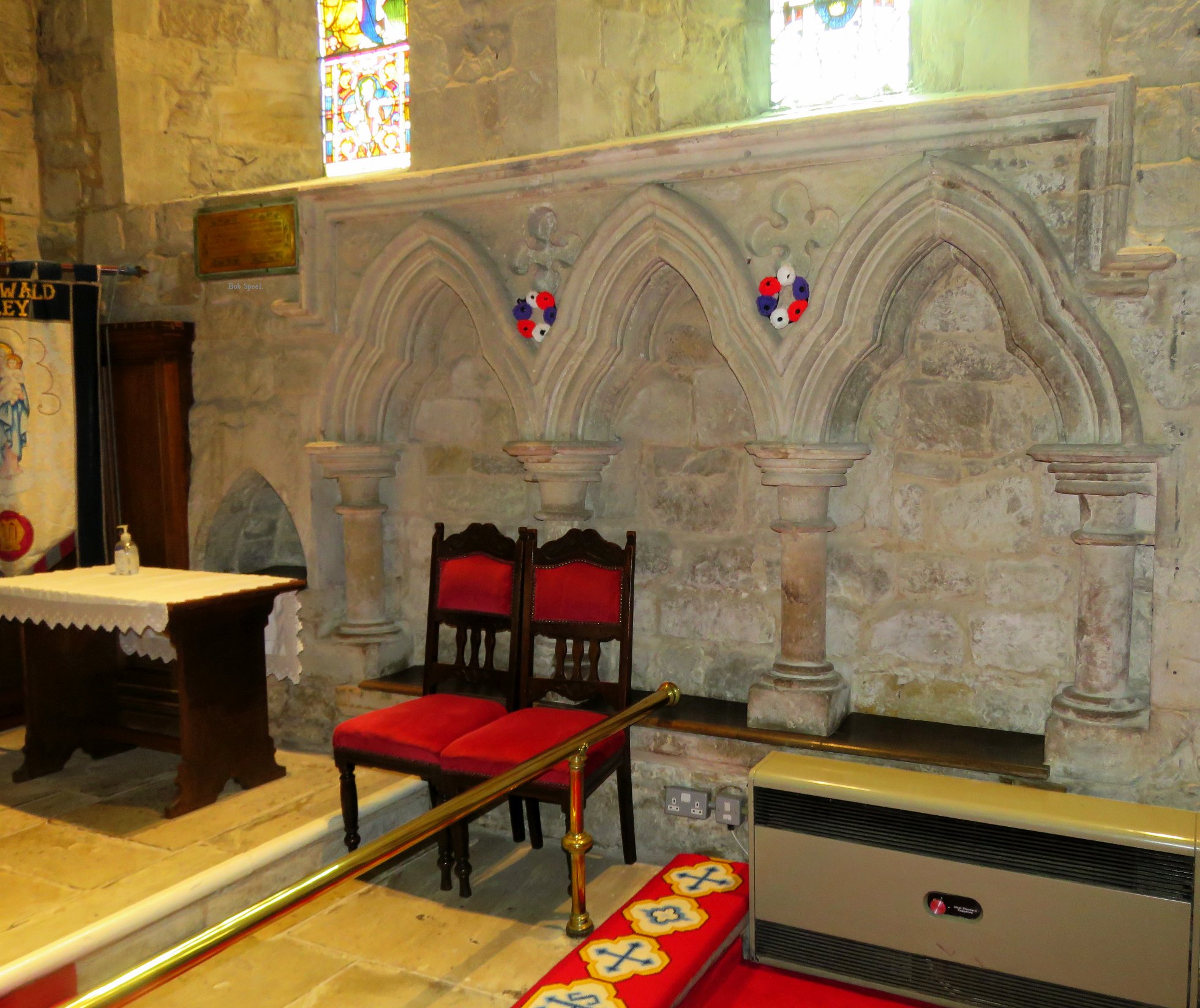
Sedilia, seats for Church officials.
A great slab of an altar table, carved with five crosses though I did not see them all. It can be seen in the interior nave shot at the top of the page.
Several small brasses, inscriptions only, to members of the Beswick, Grindall and Lister families, 18th-19th Centuries. Also John Binnington Robson, d.1894, and his wife Mary Susannah Robson, d.1900, plain.
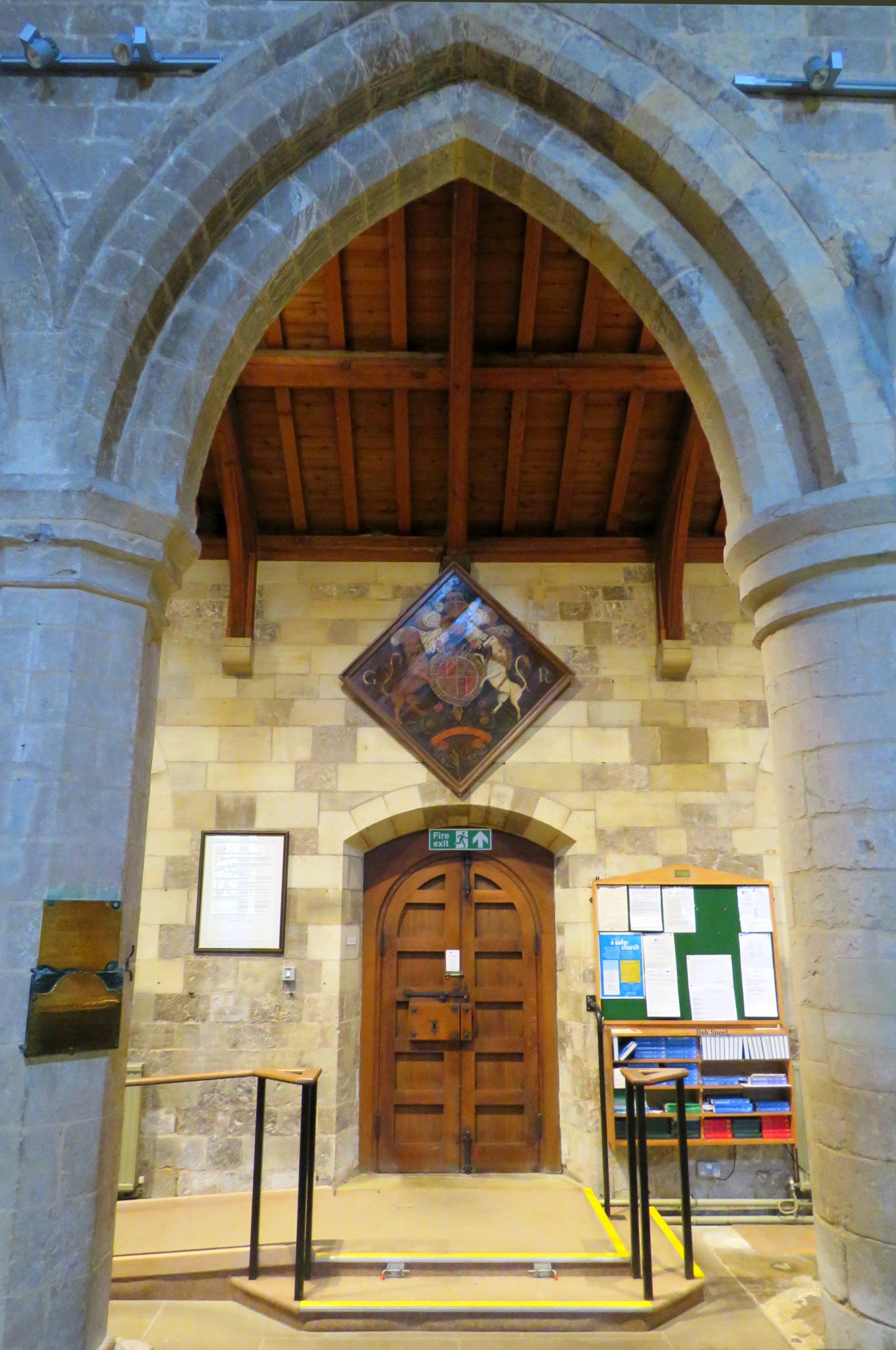
A hatchment.
A modern alabaster cast of the Epiphany panel on the San Giovani, Florence door by Ghiberti.
Some good Victorian stained glass, example below left.
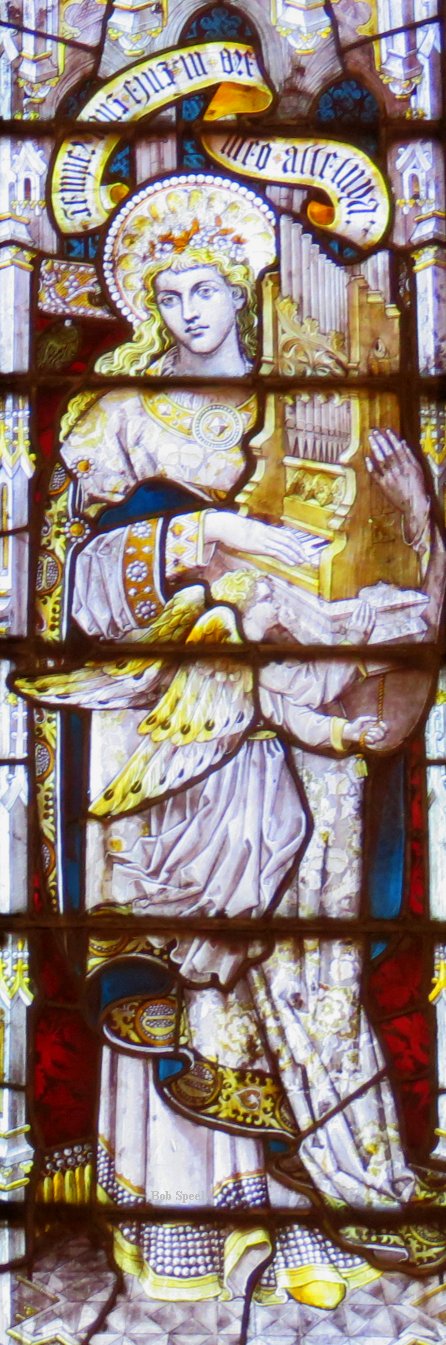
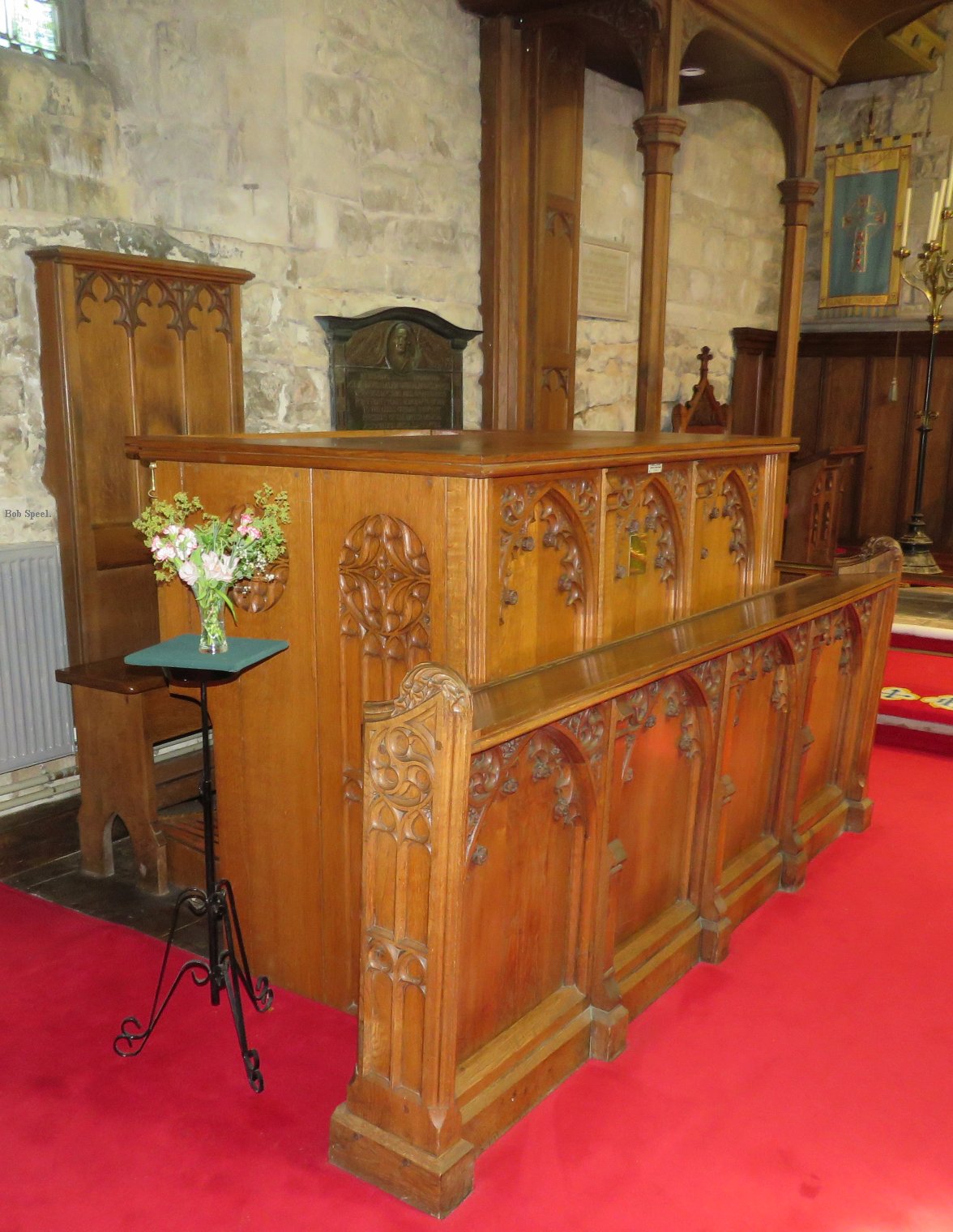
Some well-carved wooden furnishings (see picture above right), including throne, wooden hexagonal pulpit with symbols of the Evangelists on the base, and choir stalls with carving, and misericords on the latter. An ancient end to a bench is mounted on a wall inside the porch.
A brass eagle lectern.
Window from the Convent of the Sacred Heart, 1906-68, in memory of Sister Clare and the community.
A tabled recording names of Filey fishermen who perished at sea and whose bodies were never found, from 1901-40 – the surnames of Camish, Grimlisk and Jenkinson appear time and again.
Churchyard
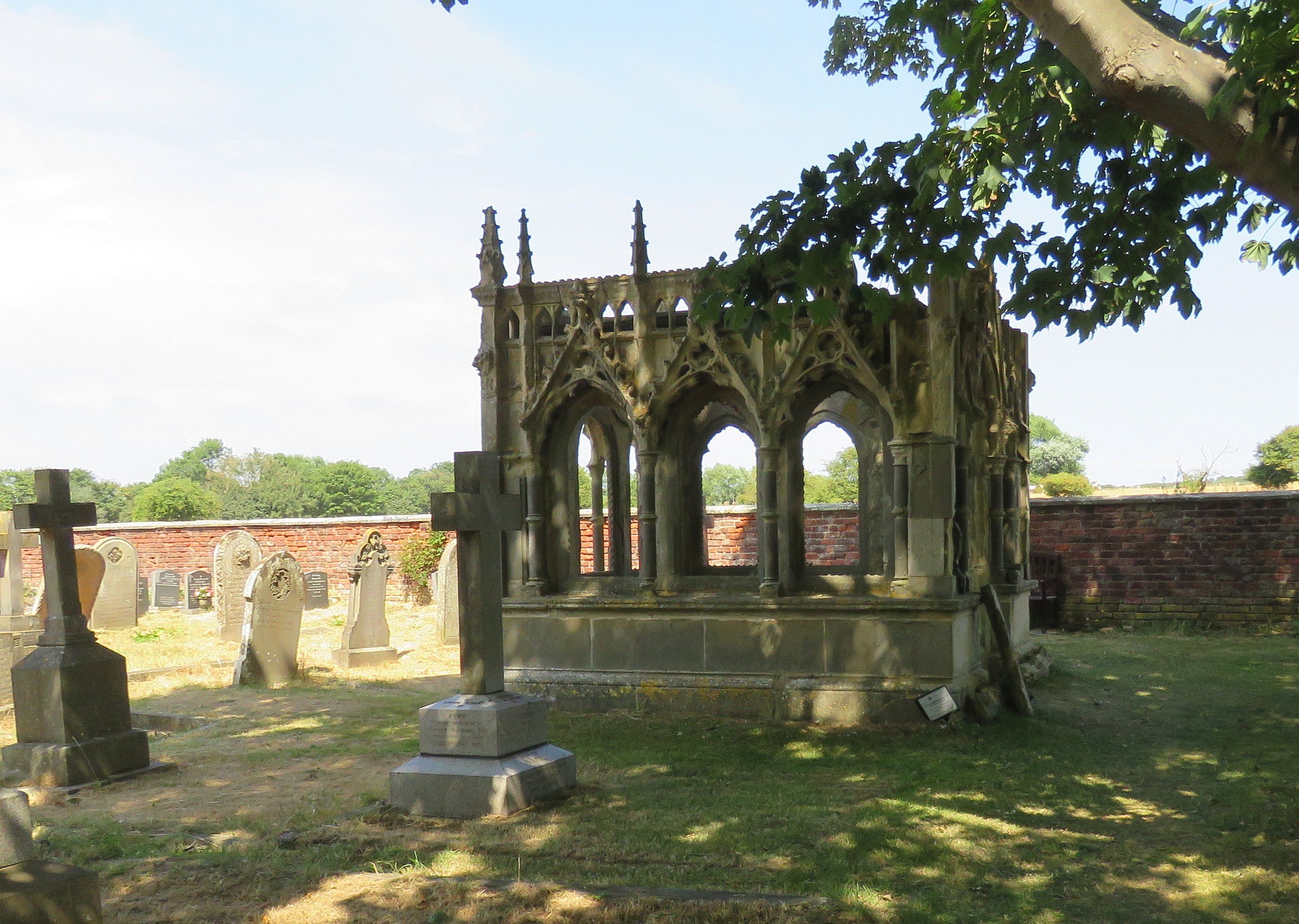
Mausoleum in the Churchyard.
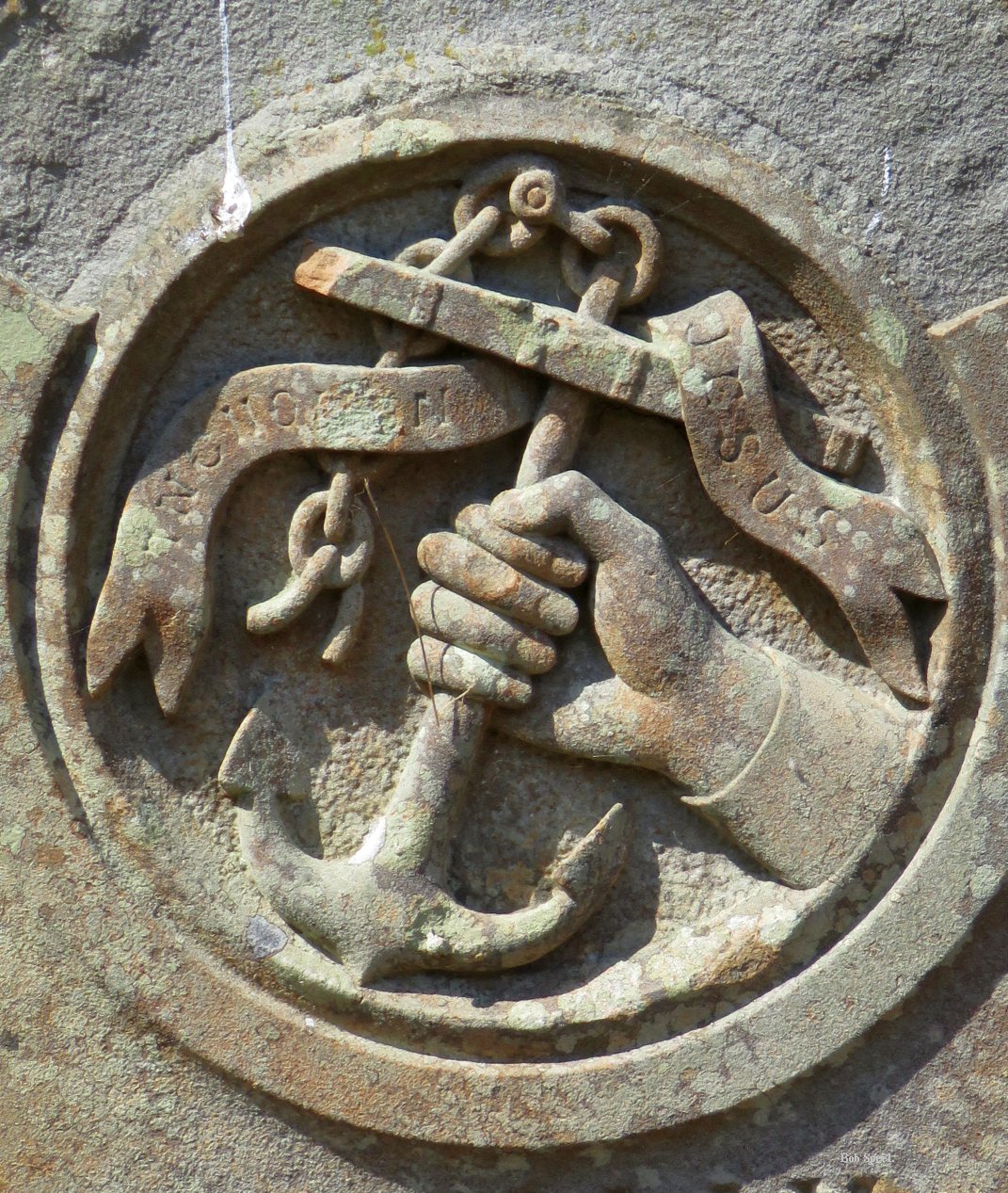
The dedication of the Church to St Oswald reflects that he is the patron saint of fishermen, and out in the busy Churchyard are various gravestones with representations of ships, anchors etc. Also among the graves are carved lunettes showing an angel or mourning woman by a dying tree, symbol of the deceased, as well as the more usual floral carvings, crosses etc. And one rather grand mausoleum, Gothic with an open top and Victorian tiles, to members of the Rudston family.
The Church website is at https://www.fileyparish.org.uk/st-oswald-s.
